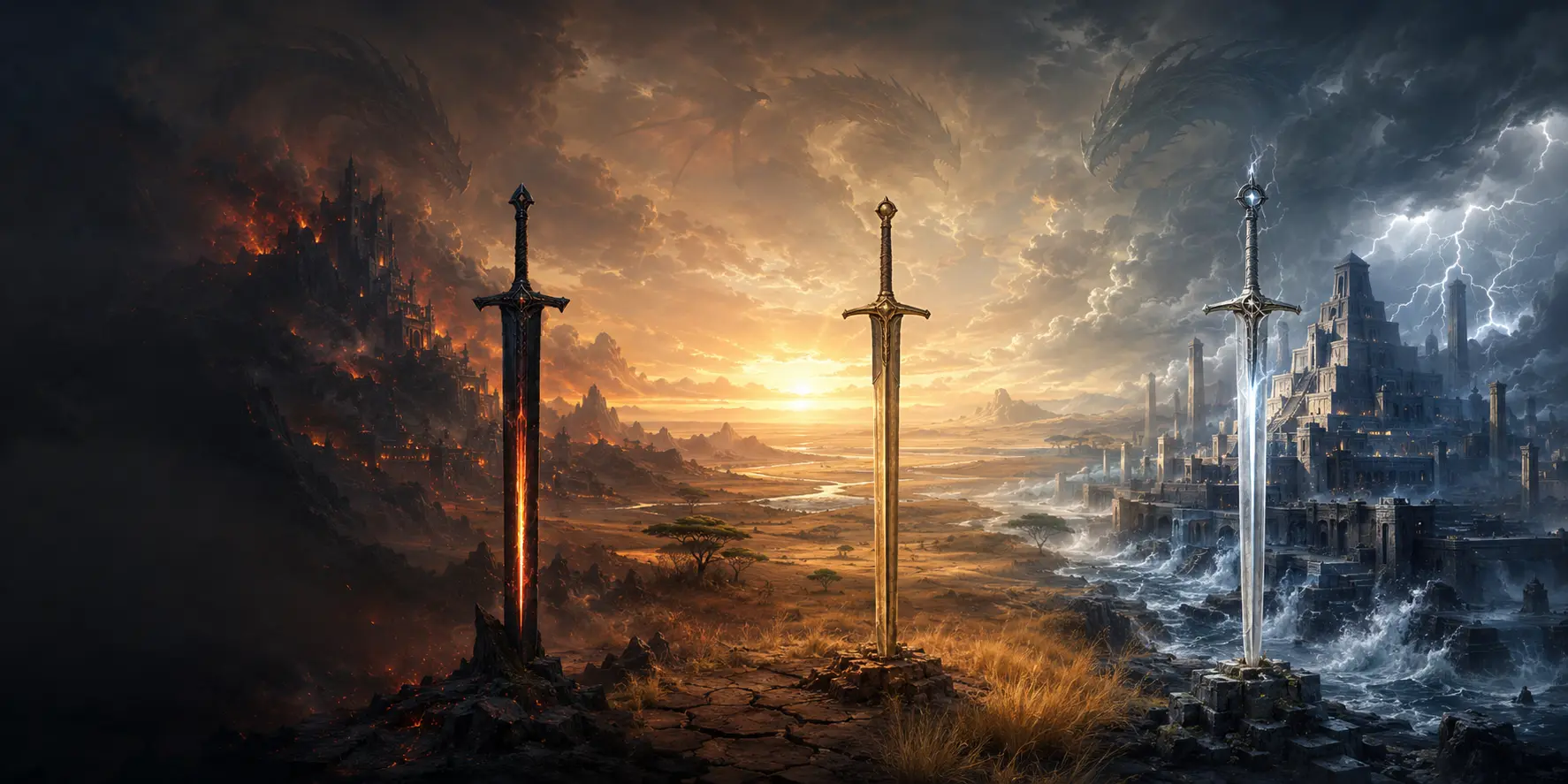
Three fantasy realms of iron fire, savanna soil and a storm-bound maritime city, each guarded by a sword

A mythic fantasy trilogy

Three swords.
Three kingdoms.

Every virtue carries its own ruin.

Enter the Lorddom
00

The premise

God left the world in the care of three dragons. Then came the Seed of Corruption: a sickness that takes root not only in flesh, but in certainty, grief, faith, ambition and every institution people build.

Each sword creates a ruler, a political culture and a different answer to goodness. Each answer succeeds magnificently before its hidden flaw becomes impossible to ignore.

Why remain good when goodness may not save you, God may not answer, and history may never vindicate you?

The rise of the Lorddom

Three rulers. Three incomplete truths.

War gives way to peace, peace to catastrophe, and three human civilisations are drawn into a single realm built upon moral tests that were never as simple as their legends claimed.

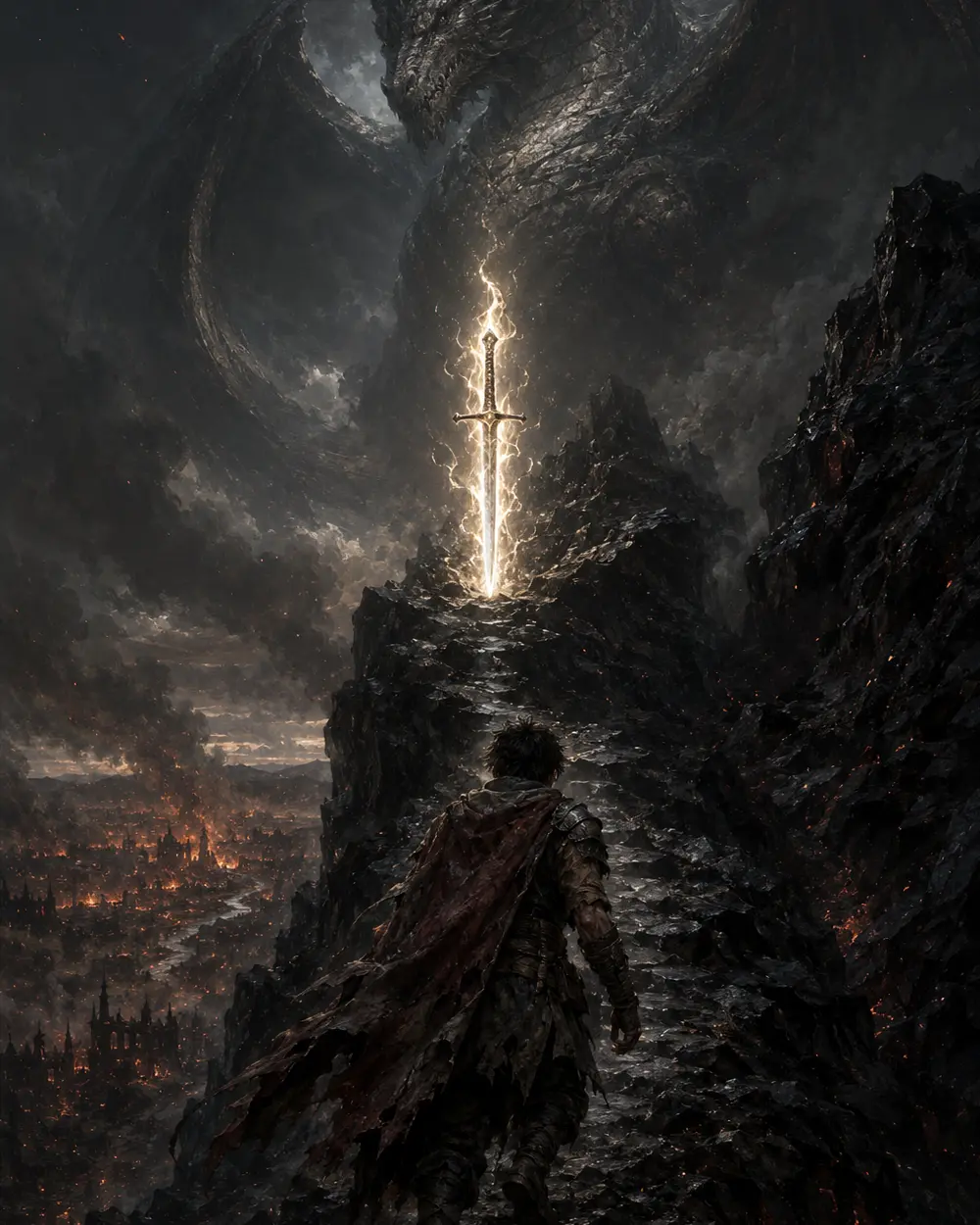
A young soldier climbing toward a dragon above the ruins of his village
Book IWar · mountains · fire

The Ironmen

The Sword of Righteousness

A village boy condemns the dragon that destroyed his infected home—and is given the power to prove he can wield judgement more humanely.

Who has the right to decide that some must die so others may live?
Trace the ruler's tragedy
  1. He volunteers for a pointless war so the vulnerable of his village will not be taken.
  2. He returns to ash, buries every villager as a person, and climbs the mountain to confront their guardian.
  3. The Dragon of Duty gives him the sword as a challenge: You believe I was wrong. Do better.
  4. He unifies the Ironmen, then slowly turns protection into control and moral conviction into law.
  5. When the sword finally refuses him, the companions who built his kingdom accept responsibility for ending his rule.

Make sure I can never exist again.

Continue to Book II
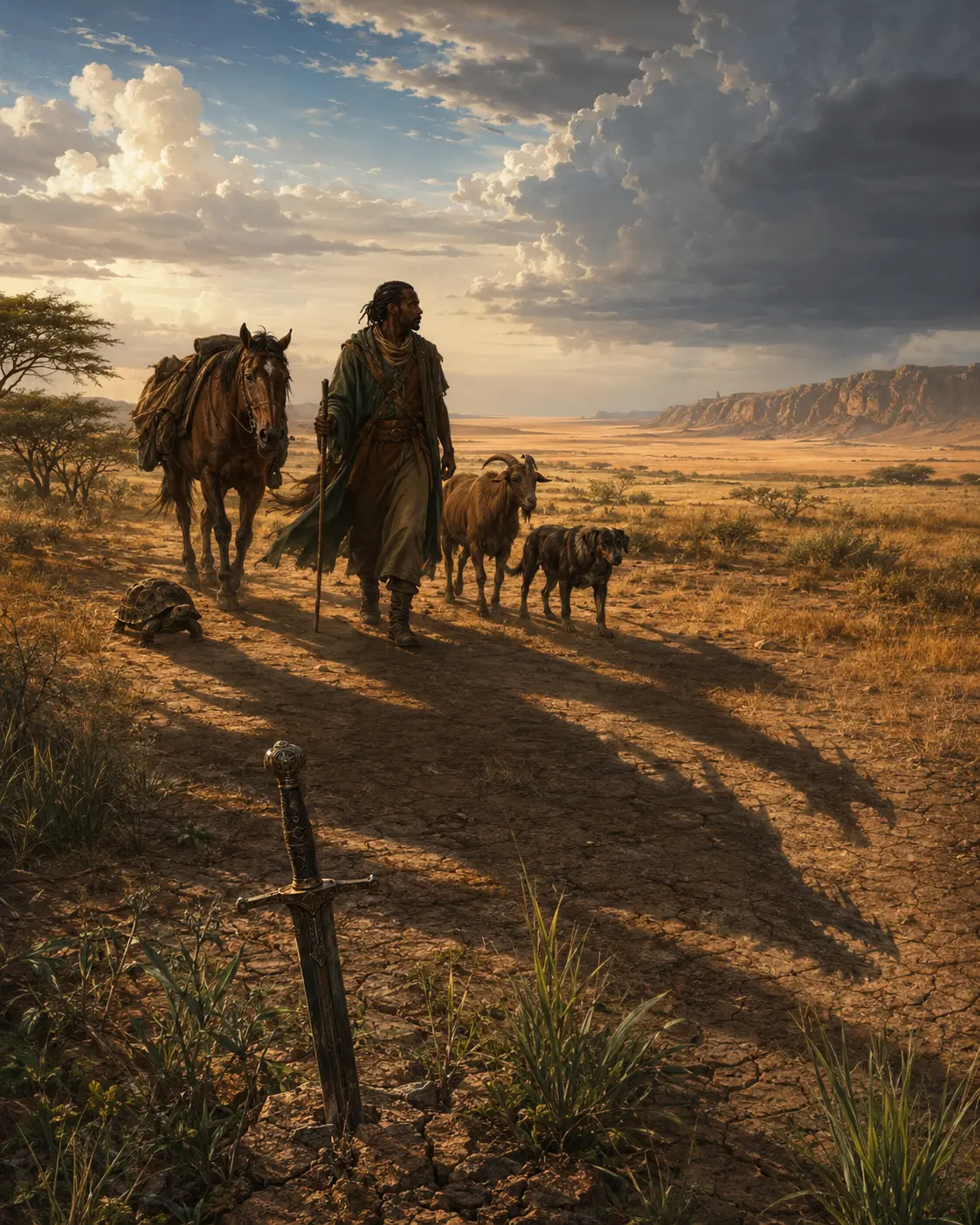
A Horseman crossing the savanna beside animal companions whose shadows form a dragon
Book IIPeace · grasslands · soil

The Horsemen

The Sword of Virtue

A Horseman crosses forests, mountains and desert seeking a legendary guardian, yet cannot recognise the relationship already walking beside him.

Can people truly connect without turning relationship into another tool?
Trace the ruler's tragedy
  1. He believes his reverence for nature entitles him to communion with the Dragon of Soil.
  2. The elves, dwarves and Lost Men each reveal a form of relationship he initially mistakes for sacrifice, materialism or primitiveness.
  3. The sword appears when he admits that he has treated every people as a route toward his own grand encounter.
  4. He returns to unite the Horsemen through diplomacy, loyalty and marriage, then approaches the Iron state beneath a white flag.
  5. Only late in life does he learn that the humble animals beside him were the dragon he spent his life seeking.

The dragon knew him. He did not know the dragon.

Continue to Book III
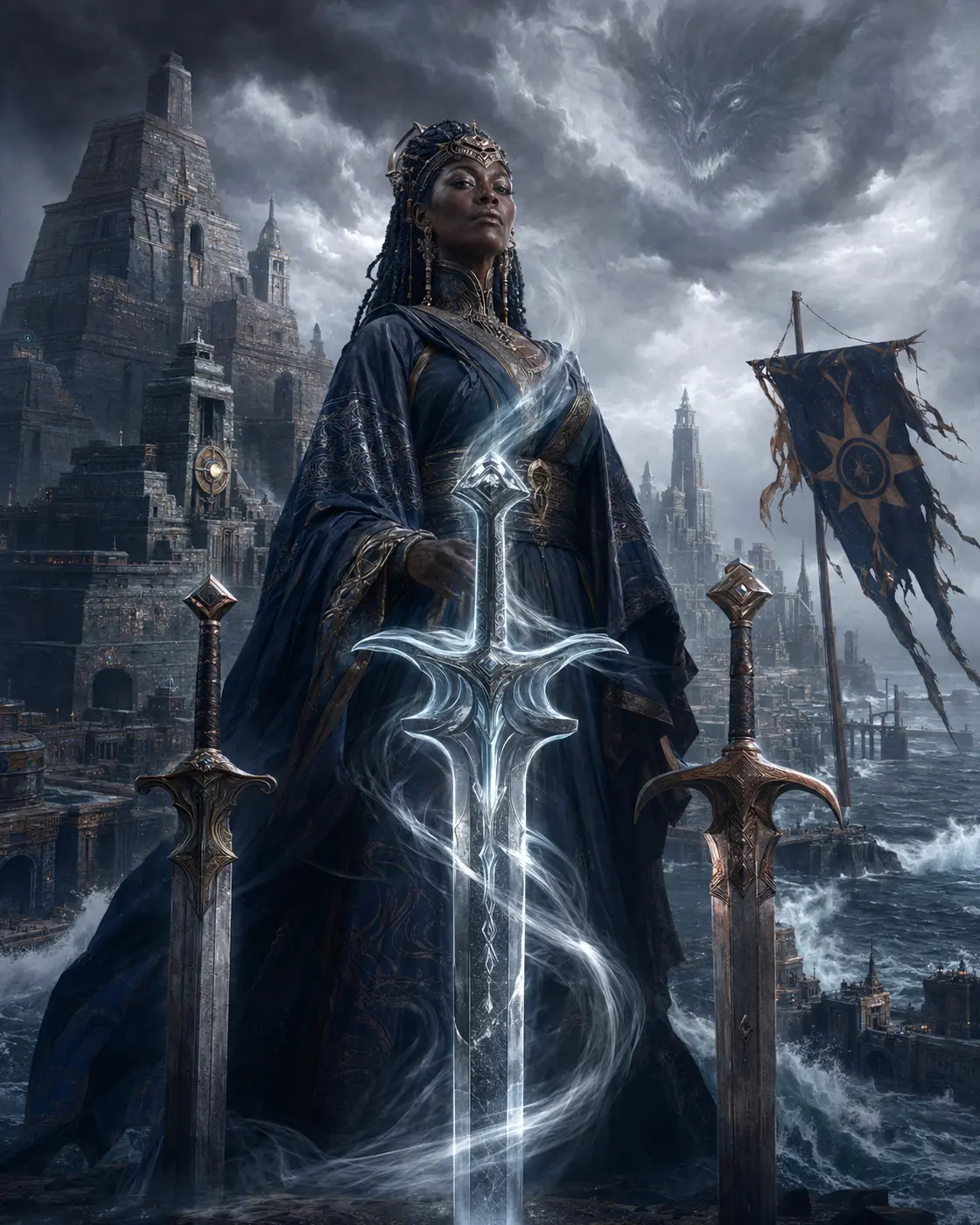
A woman king standing above a storm-bound temple city with three swords
Book IIICatastrophe · sea · wind

The Seafolk

The Sword of Wisdom

A woman king masters all three swords, defeats the greatest corruption in history and unifies humanity—then exempts her son from every lesson she gave the world.

Can wisdom remain impartial when consequence must reach someone loved?
Trace the ruler's tragedy
  1. Born of Seafolk royalty and an Iron mother, raised among Horsemen, she learns that every culture defines legitimacy differently.
  2. She crosses the World Bridge and finds the technologically supreme Ubermen preserving their purity into extinction.
  3. Trusting the Dragon of Wind, she combines the strengths of every people and crushes the corrupted priesthood.
  4. Her naturally born human–Uberman son proves that survival required transformation, but she protects him from every consequence.
  5. He tears the Lorddom apart to inherit a throne that can only be claimed through moral capacity. She loses him, and then herself, to the war she foresaw.

I wish I had never been wise.

Understand the swords
01

The moral instruments

Gift, test and beautiful trap

The swords never prove that someone is good.

They test one inward capacity at a time. Politics turns that partial truth into a complete theory of human worth.

01

Tests Sincere conviction

The Sword of Righteousness

GiftIt can be drawn by one who truly believes they are doing right. Its flame answers to purity of intention.

DangerSincerity is not truth. Pure motives do not guarantee a humane outcome.

02

Tests Genuine relationship

The Sword of Virtue

GiftIt appears when another person is finally encountered as an end—not a symbol, a tool or a path to glory.

DangerVirtue may love the grand ideal so deeply that it overlooks goodness in its ordinary form.

03

Tests Foresight with consequence

The Sword of Wisdom

GiftIt reveals patterns, joins systems and makes long rule possible across cultures and generations.

DangerWisdom is easiest when the cost belongs to someone else.

Righteousness×Virtue×Wisdom

No principle survives alone.

02

The ancient guardians

Older than every throne

Three dragons. Three partial ways of seeing.

Guardians, not gods. Each dragon carries a truth large enough to protect a world—and incomplete enough to wound it.

The protector above the mountain

Duty

Responsibility without intimacy

It destroys infected communities to contain the Seed. It may be correct—and still fail to see the individual people who pay for its judgement.

The elusive friend of the wilds

Soil

Relationship without grandeur

Elves reach it through ritual, dwarves through the earth, and the Lost Men through friendship. It wants neither worship nor extraction; it wants to be known.

The patient witness of endings

Wind

Foresight without tenderness

It sees the pattern before the people living it. Its predictions are devastatingly sound, yet suffering can become merely the proof that it was right.

The Seed of Corruption

Evil does not replace desire. It teaches desire to justify itself.

The Seed mutates beasts and contaminates landscapes, but its most dangerous form lives inside religions, states, technologies and inherited beliefs. It makes existing fears and ambitions feel necessary, sacred and inevitable.

03

The peoples of the world

Cultures shaped by survival

No civilisation is a moral shorthand.

Every people carries a way of living worth preserving—and a failure that grows from the same soil as its strength.

01

Ironmen

Mountain kingdoms · law · institutions

Righteous certainty

02

Horsemen

Grassland clans · kinship · diplomacy

Virtuous idealisation

03

Seafolk

Temple cities · trade · knowledge

Progress without restraint

04

Ubermen

Island makers · longevity · mastery

Purity unto extinction

05

Elves

Feral forests · ritual · communion

Life treated as power

06

Dwarves

Mountain stewards · stone · maintenance

Care made impersonal

07

Plaguemen

Victim · enemy · citizen · disease

The boundary of personhood

The kingdom all three create

The Lorddom of Swords

A throne that cannot be inherited. A King who need not be a man. A realm stewarded until someone can wield at least one of the swords.

IronLaw and institutions

HorseDiplomacy and relationship

SeaKnowledge and administration

No gift—righteousness, virtue, wisdom, exceptional blood, divine weapons or political unity—can substitute for accountability.